UST-USD capital flight charts

  • Our favourite US capital flight chart analytics
  • Updated as of date above
  • Valuation & positioning metrics for USTs, USD and gold

Flows & liquidity analytics

  • Now with added high-frequency charts
  • Up-to-date snapshot of the most important flows & liquidity metrics
  • CB liquidity vs multiple markets
  • Private vs central bank credit
  • Mutual fund+ETF flows
  • CB balance sheet details

The radicalism of a Warshian Fed

  • Markets are starting to recognize the radicalism of a Warshian Fed
  • But they are pricing its impact too narrowly
  • The key involves understanding the link between balance sheet, rates, and affordability

Free clip: Throwing bad money after good

  • Free clip from 23 Jan webinar
  • Consensus around 2026 forecasts is completely at odds with real-world uncertainty
  • The trick for investors is finding ways to position for underpriced regime change risks without simply disinvesting
  • First 15 minutes free to view; full version only for clients with Group Webinar and One-on-one subscriptions

Replay: Throwing bad money after good

  • Full replay of 23 Jan webinar
  • Consensus around 2026 forecasts is completely at odds with real-world uncertainty
  • The trick for investors is finding ways to position for underpriced regime change risks without simply disinvesting
  • First 15 minutes free to view; full version only for clients with Group Webinar and One-on-one subscriptions

Throwing bad money after good

Presentation cover page
  • Street forecasts for a 2026 show a remarkable consensus
  • This is completely at odds with elevated real-world uncertainty
  • The gap reflects markets’ struggle to price potential for regime change as institutions and assets are pushed towards breaking points
  • The trick for investors is to find positions which are robust to regime change before it becomes everyone’s forecast

The enshittification explanation

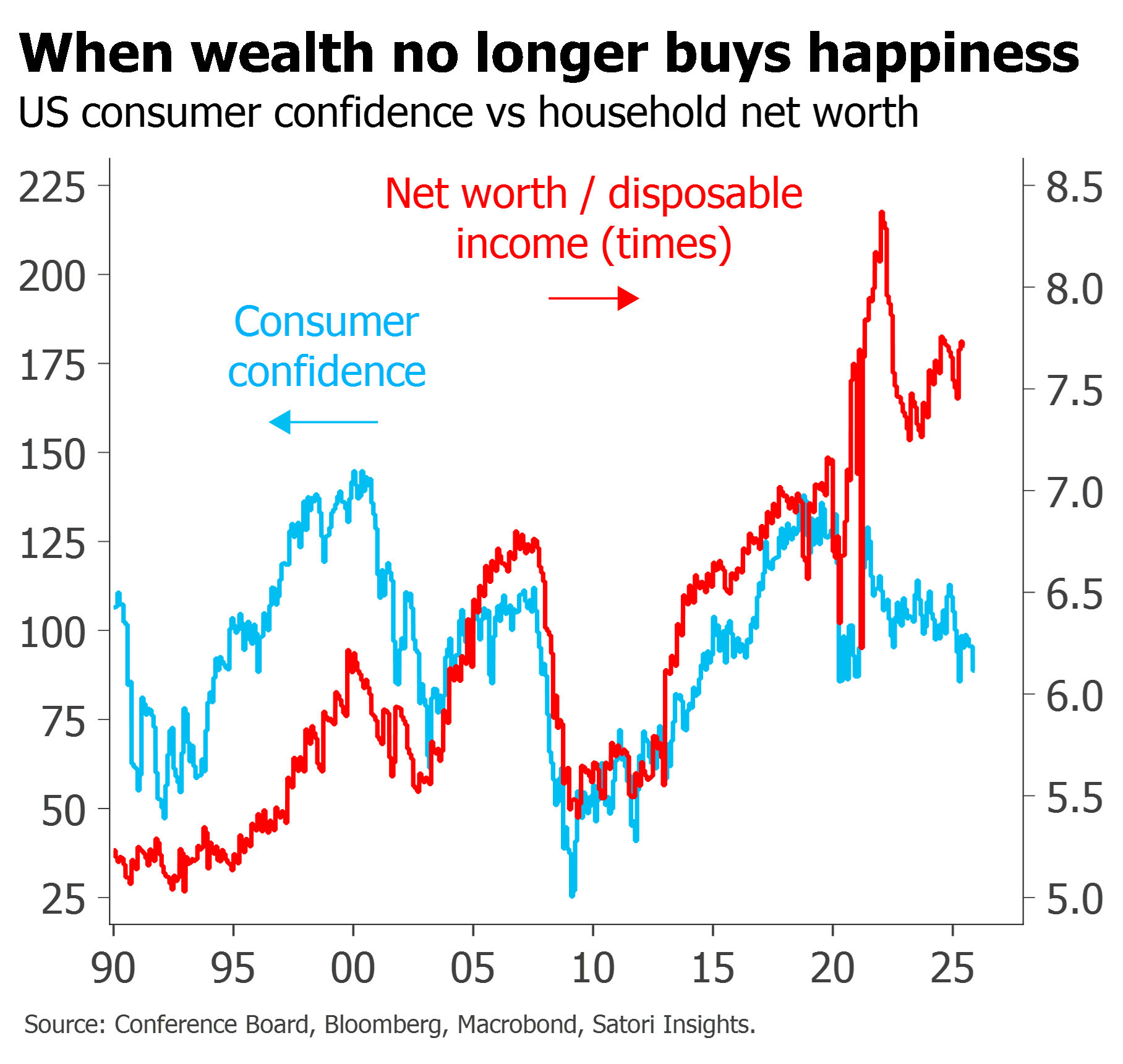
  • The more markets rise, the greater is the gap to consumer sentiment
  • We are used to explaining this in terms of a K-shaped economy
  • But together with record profit share and margins and the narrowness of the equity rally, it is also consistent with monopolization, regulatory capture and enshittification
  • This helps explain why not only labour but also consumers are suffering, implies a critical role for politics – and ultimately paints a more fragile picture of society collapsing towards technofeudalism

When froth turns to fear

  • Markets are reeling from a monetary triple whammy: repo tightness, a faltering of other forms of credit creation, and a record $900bn in reserves drainage
  • But all these sources of monetary tightness ought to ease
  • The question is whether this episode drives a more enduring reduction in risk appetite and fund flows

Why shutdown squeezes funding

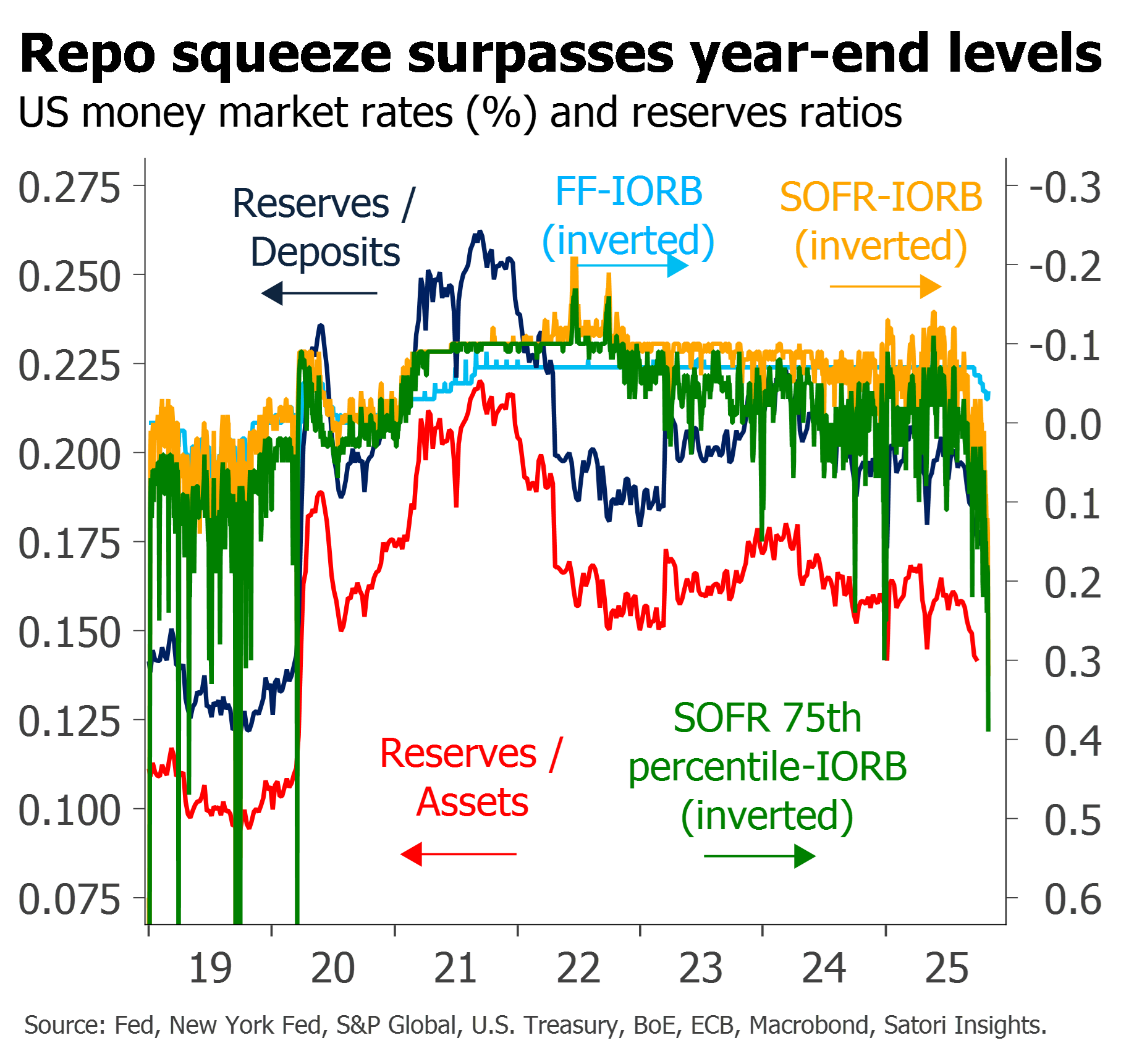
  • US repo rates have already spiked beyond year-end levels
  • The squeeze seems likely to continue – and intensify – while the US government shutdown does
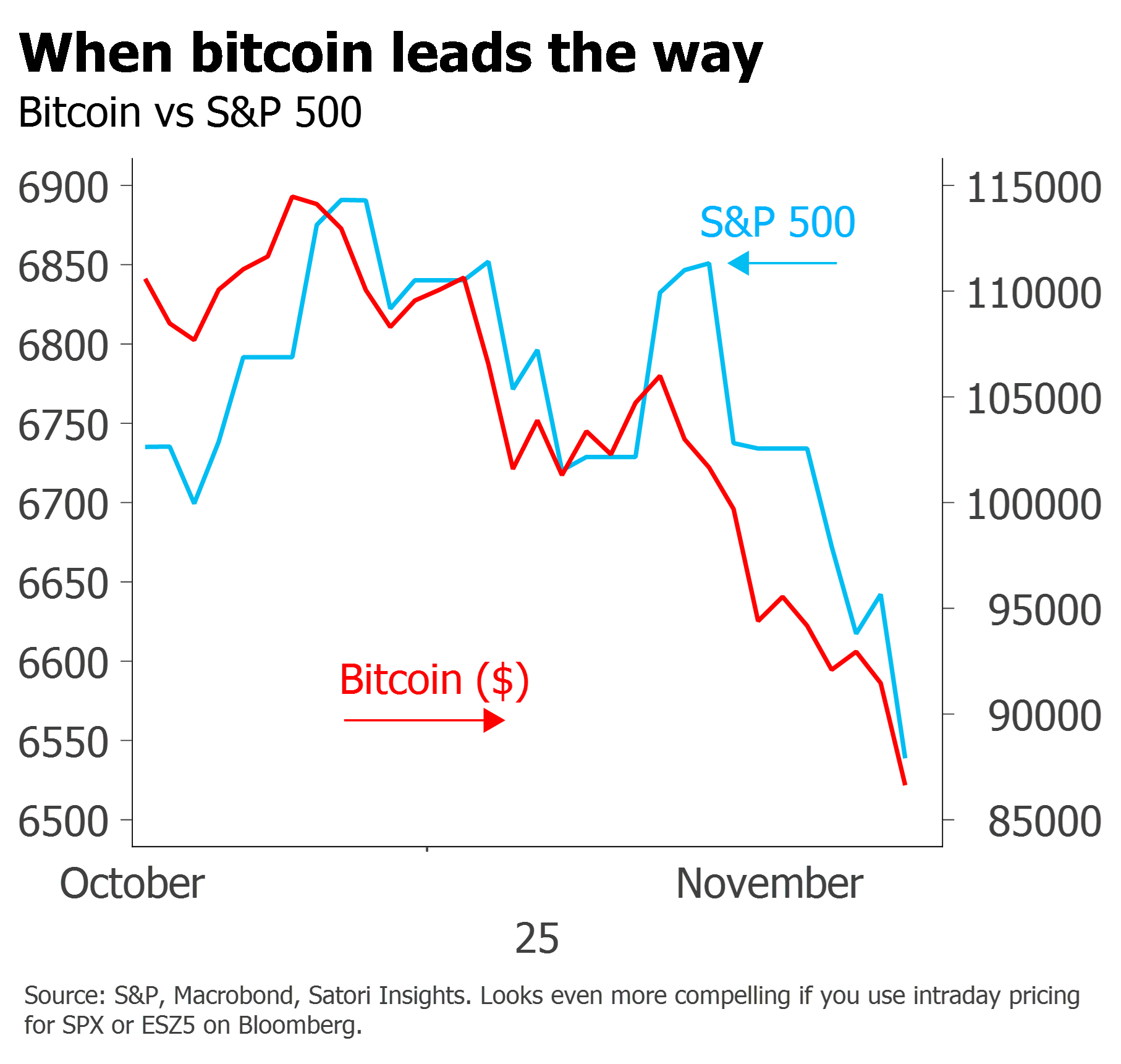
  • The immediate consequences are $-positive and risk-negative – but mostly point to a deeper unwind of crowded hedge fund positions

The blinkered Fed

  • In a narrow technical sense, the FOMC was indeed hawkish
  • But in the cessation of QT and through questions, it more broadly reconfirmed a reaction function at once deeply asymmetric and completely oblivious to asset price inflation
  • This paves the way for a further melt-up in risk assets and havens – and for more assets to exhibit the sort of exponential sawtooth boom-bust recently seen in gold

Replay: The limits of easy money

  • Full replay of 22 Oct webinar
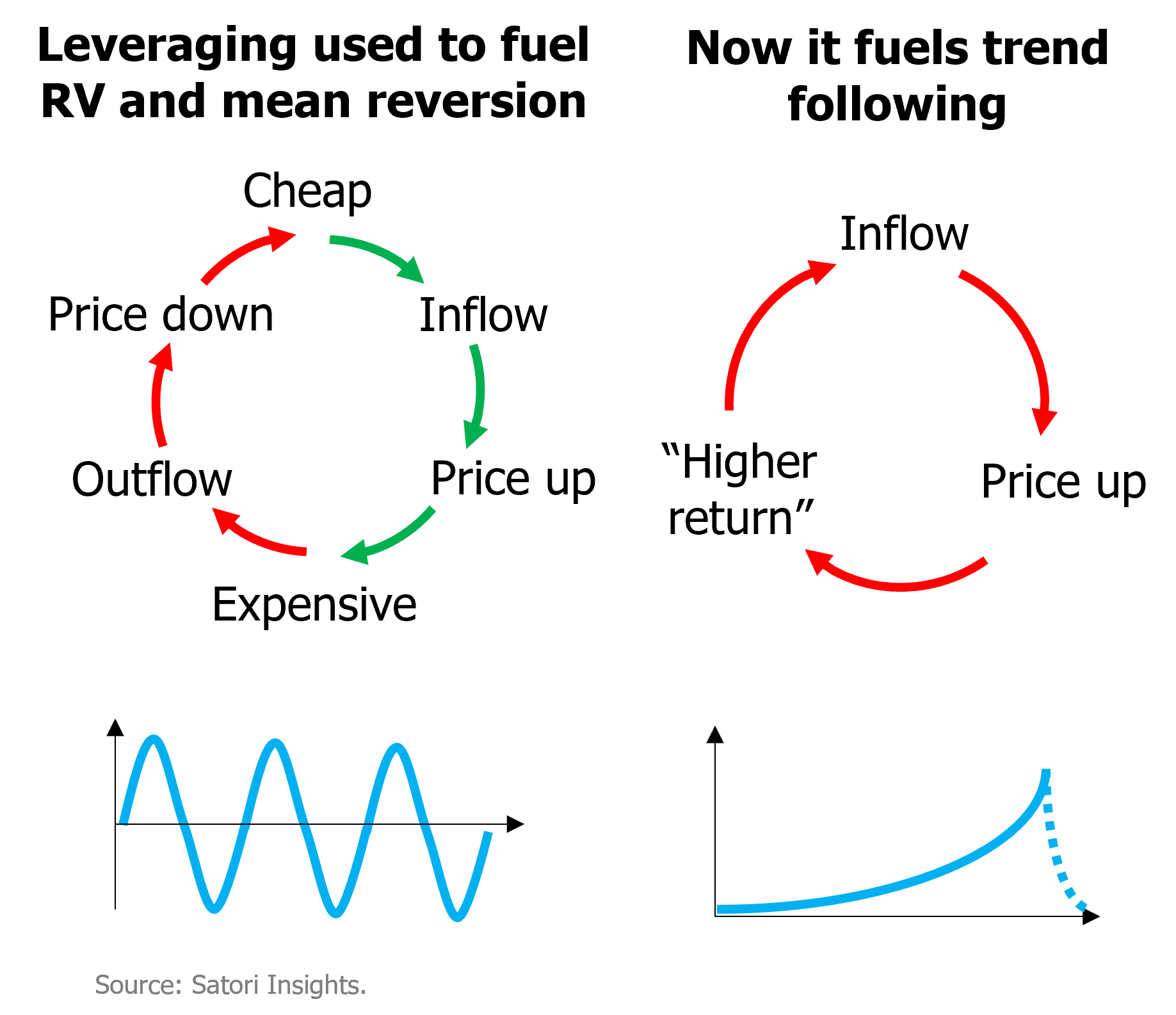
  • The fuel for the rally comes from a mix of fiscal stimulus being channelled into fund flows and financial sector leveraging
  • But cracks are beginning to appear, from First Brands, to doubts about circular financing in tech, to the flight into gold
  • To understand the limits of leveraging, look at the fund flows
  • First third free to view; full version only for clients with Group Webinar and One-on-one subscriptions

Free clip: The limits of easy money

  • Free clip from 22 Oct webinar
  • The fuel for the rally comes from a mix of fiscal stimulus being channelled into fund flows and financial sector leveraging
  • But cracks are beginning to appear, from First Brands, to doubts about circular financing in tech, to the flight into gold
  • To understand the limits of leveraging, look at the fund flows
  • First ten minutes free to view; full webinar only for clients with Group Webinar and One-on-one subscriptions

The limits of easy money

  • The fuel for the rally comes neither from rates, nor from fundamentals, nor from central bank liquidity
  • It stems from a mix of fiscal stimulus being channelled into fund flows and financial sector leveraging
  • The resultant mix of too much money chasing too few assets both suppresses risk premia and postpones credit events – to a point
  • But it remains critically dependent on the continued credibility of the borrowers and the system

The long-bond problem

  • The recent “bond rout” would be better described as a long-end bond technical
  • It reflects dwindling pension demand more than existential fears around inflation or debt sustainability
  • Governments should reduce their long-end issuance accordingly
  • Investors should continue to hold steepeners until they do – without necessarily being short duration

Trading a decaying hegemon

  • The more Trump exerts personal control over US organs of state, the more the US’ real power is eroded
  • The main mystery is why this is still not being priced into markets
  • Part of the answer revolves around the amorality of capitalism, and prospects for more easy money
  • But much is attributable to the extreme and abrupt nature of credit repricings

When does liquidity turn to fumes?

  • Commentators argue increasingly that tariffs matter little, and for the return of US and tech exceptionalism
  • But this risks retro-fitting the explanation to the price action
  • An examination of the monetary data points to the exceptional way in which fiscal stimulus has been fuelling equities

Free clip: Scale and scalability

  • Free clip from 8 Jul webinar
  • The single greatest force driving modern economies, society and politics is scalability
  • It is the common narrative underlying the dominance of big tech, through to the teen mental health crisis and the rise of political polarization and populism
  • Markets tend to treat scale as a largely linear concept
  • But human systems change character at scale – and ultimately have breaking points
  • Clients with Group Webinar or One-on-One subscriptions should log in to see the full version

Replay: Scale and scalability

  • Full replay of 8 Jul webinar
  • The single greatest force driving modern economies, society and politics is scalability
  • It is the common narrative underlying the dominance of big tech, through to the teen mental health crisis and the rise of political polarization and populism
  • Markets tend to treat scale as a largely linear concept
  • But human systems change character at scale – and ultimately have breaking points
  • Open to clients with Group Webinar or One-on-One subscriptions, and to the press

Scale and scalability

  • The single greatest force driving modern economies, society and politics is scalability
  • It is the common narrative underlying the dominance of big tech, through to the teen mental health crisis and the rise of political polarization and populism
  • Markets tend to treat scale as a largely linear concept
  • But human systems change character at scale – and ultimately have breaking points

More on Section 899

  • Like tariffs, Section 899 continues the Trump administration’s declaration of economic war against erstwhile allies
  • As with tariffs, there remain considerable questions about the scale and scope of its eventual application
  • But the net effect should still be to cause foreign investors of all types to question their investments in America

Shorting spendthrift sovereigns

  • Even before Trump’s EU tariff tweets, the risk rally had seemed unconvincing
  • This is in part because bond market developments are so concerning
  • But we think there are better ways to position than outright shorts in 30y govies

Gradually, then suddenly

  • The bounceback in risk is unconvincing
  • This is in part because of overoptimism that tariffs and economic pain can be avoided
  • It is also because sentiment across markets has moved much more than actual positions
  • But ultimately it is because Hemingway’s famous quip applies as much to reserve currencies as to personal bankruptcy

Replay: From win-win to lose-lose

  • Full replay of 11 Apr webinar
  • It’s not just that tariffs are still not priced
  • The increasingly alarming price action in Treasuries and the $ threatens to take down other markets
  • Open to clients with Group Webinar or One-on-One subscriptions; Read-only clients have access to first section only

Free clip: From win-win to lose-lose

  • Free excerpt from 11 Apr webinar
  • It’s not just that tariffs are still not priced
  • The increasingly alarming price action in Treasuries and the $ threatens to take down other markets
  • Clients with One-on-One or Group Webinar subscriptions should log in to see the full replay

Three thoughts on tariffs

  • The announced headline tariff rates are all over the place
  • But tariffs in general are more punitive than consensus expected, even after the inclusion of VAT
  • The immediate market response is being clouded by liquidity factors

T-Day landings and liquidity

  • Despite all the attention to tariffs, short-term market moves remain surprisingly well correlated with CB liquidity
  • Liquidity dynamics have the potential to amplify any T-Day relief rally
  • But we would still fade any such move thereafter

Deficits, debt, and dollar devaluation

  • It is remarkable that proposals for a Mar-a-Lago accord have not yet sparked an even greater flight out of US dollars, debt, and risk
  • That they have not yet done so is thanks to a mix of incredulity, inertia, and temporary liquidity factors
  • Current account deficits, though a source of vulnerability, are in many respects a measure of attractiveness to foreign capital
  • What’s damaging is when – as in the US – they are allowed to turn into ever-escalating debt
  • What the Mar-a-Lago proposals’ discussion of sticks and carrots lacks is a proper notion of trust – and of the scale and suddennness of the consequences once it has been lost

Seriously and literally

  • Markets’ response to the evident risks has thus far consisted primarily of risk rotation
  • This seems increasingly likely to evolve into full-fledged risk reduction
  • That it has not done so to date is thanks not only to dwindling hopes that Trump is bluffing, but also (yet again) to support from central bank liquidity

QT and the debt ceiling

Fed reserves changes vs credit spreads, rolling 6m
  • Fed Minutes suggest pausing QT “until” resolution of the debt ceiling
  • This would amplify market volatility, not reduce it
  • Either the Minutes are poorly drafted, or else reflect deeper misunderstandings of how balance sheet policy affects markets

When shocking behaviour meets shock-proof markets

  • US economic exceptionalism remains alive and well
  • But in markets, many Trump trades have been faltering
  • Markets’ overall behaviour remains Panglossian thanks to a combination of falling real yields, a temporary boost from CB liquidity, and animal spirits
  • But we see reasons to doubt the longevity of all three

Free clip: When the positives are all priced

  • Free excerpt from 22 Jan webinar
  • The US economy is indeed exceptional
  • But the performance of its markets owes just as much to an extraordinary funnelling of fund flows
  • Dissecting the drivers of these flows sheds crucial light on the durability or otherwise of the risk rally
  • Free to view by all; full replay available only to clients with Group Webinar or One-on-One subscriptions

Replay: When the positives are all priced

  • Full replay of 22 Jan webinar
  • The US economy is indeed exceptional
  • But the performance of its markets owes just as much to an extraordinary funnelling of fund flows
  • Dissecting the drivers of these flows sheds crucial light on the durability or otherwise of the risk rally
  • Open to clients with Group Webinar or One-on-One subscriptions; Read-only clients have access to first section only

What role for liquidity in 2025?

us equities appear to decouple from cb liquidity
  • It is tempting to look at the performance of US equities in 2H24 and conclude that central bank liquidity no longer matters for markets
  • But a closer examination of both other markets and shorter timescales suggests this would be a mistake
  • It instead highlights the predominant role currently being played by fund flows and US exceptionalism
  • While it is possible to paint scenarios where liquidity contributes to a melt-up in risk in early 2025, on balance we see it as one of a number of reasons to be skeptical of the bullish consensus

Ten reasons to take profit

  • Many fundamental indicators show a sudden deterioration
  • In combination with markets’ Panglossian interpretation of prospects under Trump, these represent reasons to take profit
  • Too much of markets’ performance comes from a fiscally-driven surge in fund flows

Which Trump trades still have juice?

  • Trump’s triumph is testament not only to the inadequacies of the Democratic campaign and the electorate’s dislike of inflation, but to the popularity of populism globally
  • Trump trades likely to continue at least until inauguration, and conceivably thereafter – unless a bond rout stops them first
  • The right places to position are America-first trades which will benefit from – or at least withstand – higher term premia

Trump trades look overdone

  • The election remains too close to call
  • But market pricing has moved decisively towards Trump
  • Take profit on Trump trades – or use options instead

Replay: Pricing the policy put

  • Full replay of 16 Oct webinar
  • Markets’ aggressive pricing of a soft landing is matched only by central banks’ determination to provide it
  • Yet their dovishness masks a switch from rate tightening and balance sheet easing to rate easing and balance sheet tightening
  • The resultant uncertainty is largely reflected in rates – but leaves opportunities in other markets
  • Open to clients with Group Webinar or One-on-One subscriptions; Read-only clients have access to first section only

Free clip: Pricing the policy put

  • Free excerpt from 16 Oct webinar
  • Markets’ aggressive pricing of a soft landing is matched only by central banks’ determination to provide it
  • Yet their dovishness masks a switch from rate tightening and balance sheet easing to rate easing and balance sheet tightening
  • The resultant uncertainty is largely reflected in rates – but leaves opportunities in other markets
  • Available to all; full replay available only to clients with Group Webinar or One-on-One subscriptions.

Pricing the policy put

Presentation cover page
  • Markets’ aggressive pricing of a soft landing is matched only by central banks’ determination to provide it
  • Yet their dovishness masks a switch from rate tightening and balance sheet easing to rate easing and balance sheet tightening
  • The resultant uncertainty is largely reflected in rates – but leaves opportunities in other markets

25, 50 and the path to financial instability

  • The 25 vs 50 rate cut debate has unsurprisingly been focused on the economy
  • But the greater importance lies in the signal the Fed would be sending to markets
  • Leading with a larger move risks reigniting financial exuberance

Short-term liquidity alert

The great wave of global liquidity passes
  • Over the past week central banks drained $300bn in liquidity: as much as in April and more than in August
  • While this was partially reflected in the post-Labor Day selloff, the risk is of more to come
  • Resilient fund inflows are a partial panacea, but risk simply lagging

Please stop meddling with my markets

cb liquidity vs spx rolling 7d
  • The best explanation for markets’ summer slump and rapid rebound lies neither with rates nor with the economy
  • It sits – yet again – squarely with swings in central bank liquidity
  • While the resilience of fund flows and cutting of leveraged positions is somewhat reassuring, on balance we still see the support as temporary

Should you believe the bounce?

  • Attempting to explain the market bounce in terms of economic data fails to do justice to the prior sell-off
  • Flows & liquidity indicators once again shed light on the moves
  • On balance they leave us skeptical

Mind the exits

  • The increase in VaR is sparking a broad-based, and potentially indiscriminate, unwinding of leveraged positions
  • The first question is which other leveraged positions are at risk
  • The second question is whether fund flows will hold up
  • Central bank rescue easing or liquidity packages are likely only with a much bigger sell-off or more obvious signs of systemic leveraged distress

What rotation can’t cure

  • The violent rotation in equities is sparking hopes of a fundamentally-driven rally
  • It has been aided by record fund inflows and a spike in CB liquidity
  • But the details of both the flows and the liquidity leave us skeptical
  • Expect the rotation to continue, but not the rally

Free clip: Who pulled the plug?

market has momentum webinar replay screenshot
  • Free clip from first ten minutes of 3 July webinar
  • Even as the rally continues, it does so on ever more fragile foundations
  • The problem lies neither with the economy, nor with central banks being slow to lower rates, nor even with politics
  • It is that the liquidity which fuelled markets in H1 looks increasingly likely to be turned off

Replay: Who pulled the plug?

market has momentum webinar replay screenshot
  • Full replay of 3 July webinar with Q&A
  • Even as the rally continues, it does so on ever more fragile foundations
  • The problem lies neither with the economy, nor with central banks being slow to lower rates, nor even with politics
  • It is that the liquidity which fuelled markets in H1 looks increasingly likely to be turned off
  • Open to clients with Group Webinar or One-on-One subscriptions, and to the press

When star stands for confusion

r-star down, return on capital up
  • Recent statements are a reminder of the importance of neutral rates for policymakers
  • But they also illustrate confusion – not only about the level of r*, but even as to what it is supposed to be measuring
  • At the heart of the confusion lies a failure to distinguish between the impact of balance sheet on markets, and of rates on the economy
  • This potentially leads to very different conclusions for r* and policy

Seven lessons from complexity

Under conventional economics, volatility shouldn't form clusters - but it does
  • Markets and economies should be analyzed as ‘complex systems’
  • Their fat tails and emergent behaviours fit poorly with traditional linear economics, but very well with complexity modelling techniques
  • Lessons from other complex arenas apply equally well to investing

Short-term exuberance alert

trailing 12m cb liquidity down, equities up
  • We have been arguing markets face greater risk of melt-up than melt-down
  • But the speed and extent to which many levels are deviating, not only from fundamentals but even from many technicals, is striking
  • Expect fund inflows to continue to swamp such concerns – but watch for any sign of faltering

The asymmetric Fed

cash assets at small and large us banks still far from 2019 lows
  • The significance of last week’s FOMC lies neither with the rate view, nor with the earlier, larger taper of QT – mildly bullish though both of these are.
  • It comes instead from the stark asymmetry of the response function which was described.
  • While the true test remains with the details of the liquidity outlook, in conjunction with the Treasury refunding this opens the door to a continued cross-asset rally through Q2.

Free replay clip: Why are financial conditions so benign?

- Markets seem abnormally exuberant - It's not just the stronger economy - It's the impact of easy money
  • Free clip from first ten minutes of 2 May webinar
  • The exuberance in risk assets is less a consequence of a stronger economy than a driver of it
  • The expectation of rate easing was never critical – which is why the exuberance has largely persisted even as yields have backed up
  • It is instead the direct consequence of investor crowding following easy central bank balance sheet policy – and vulnerable to any reduction in CB liquidity

Replay: Why are financial conditions so benign?

- Markets seem abnormally exuberant - It's not just the stronger economy - It's the impact of easy money
  • Full replay of 2 May webinar with Q&A
  • The exuberance in risk assets is less a consequence of a stronger economy than a driver of it
  • The expectation of rate easing was never critical – which is why the exuberance has largely persisted even as yields have backed up
  • It is instead the direct consequence of investor crowding following easy central bank balance sheet policy – and vulnerable to any reduction in CB liquidity
  • Open to clients with Group Webinar or One-on-One subscriptions, and to the press

Cliff notes on credit

ccc-b spread differential ratio to hy index spreads at record highs
  • Relative CCC cliff risk has risen to record highs
  • This partly reflects hidden idiosyncratic risks from low recoveries and abandoned covenants
  • But mostly it signifies the macro suppression of index spreads

When crowding stops, markets drop

fund flows vs cb liquidity
  • The $280bn weekly drop in Fed reserves is the largest since Apr22
  • Just as then, it coincides with a correction in markets
  • A drop in fund inflows seems likely to follow
  • But this still feels more like seasonal correction than decisive turn

Why are financial conditions so benign?

presentation cover page
  • Financial conditions have eased to the same levels as 2007
  • This comes in spite of central banks thinking they are running restrictive policy
  • The nature and timing of the market moves suggest these not so much reflect or anticipate the strength of the economy as drive it
  • Their ultimate cause is easy balance sheet policy having crowded investors into risk
  • Misunderstanding of these dynamics increases the likelihood of bubbles and subsequent busts

Global QT: what central banks haven’t learned

fed reserves vs equities 6m chg
  • The latest central bank research on QT is careful, rigorous, and grounded in the literature
  • Unfortunately its main conclusion – that QE affects markets while QT doesn’t – is at odds with the lived experience of most market participants
  • There is a much simpler reason why QT has had so little apparent impact
  • Misunderstanding of this dynamic greatly contributes to the likelihood of future policy mistakes

Sticky supply, not dynamic demand

labour hoarding
  • After several months of liquidity tailwinds, risk asset pricing is starting to look excessive
  • Improving spending, orders and hiring are all positives
  • Despite this, earnings estimates are falling
  • Fundamentals are reflective more of sticky supply than of dynamic demand
  • Ongoing price pressures may well curtail central banks’ desire for dovishness
  • But excitement about higher r* remains overdone

Free replay clip: Outlook 2024

outlook 2024 webinar snapshot
  • Free-to-view replay of first segment of 16 Jan webinar
  • Why strategists struggled in 2023
  • A better way to think about markets
  • Implications for 2024

Replay: Outlook 2024

outlook 2024 webinar snapshot
  • Full replay from 16 Jan webinar with Q&A
  • Why strategists struggled in 2023
  • A better way to think about markets
  • Implications for 2024
  • Open to clients with Group Webinar or One-on-One subscriptions, and to the press

Outlook 2024: tight credit, easy money

global credit impulse private vs central bank
  • The remarkable performance of risk assets in 2023 is not primarily due to the growing likelihood of a soft landing
  • It instead reflects markets being buffeted by extraordinary amounts of central bank liquidity
  • For now, those technicals remain positive, but beyond Q1 they should fade or reverse
  • Underlying momentum in growth, earnings and inflation – beyond sticky supply-side effects – is significantly weaker

Seasonal Satorical Verses (free)

AI-generated central bank christmas scene
  • Hark! The VC angels sing
  • God rest ye, merry crypto bros
  • While PMs watched tech stocks take flight
  • I’m dreaming of a tight market
  • To be sung, please, in a spirit of global harmony

The #1 rule about outlooks

fed reserves vs spx
  • The biggest surprise of 2023 was not the resilience of the US consumer
  • It was that central banks added nearly $1tn in liquidity, rather than removing $1tn as had been widely expected.
  • This swing alone is worth 20% on equities – almost exactly the YTD gain in the S&P.
  • We think 2024 will show central banks have overtightened rates whilst simultaneously overstimulating risk assets.
  • But we also fear their misunderstanding of the dynamics means they may yet do more of both.

Some slides on the S&P rally

spx vs fed reserves 4wk chg
  • The rally does not reflect the likelihood of a soft landing
  • It is the direct consequence of a surge in Fed liquidity
  • Widespread misunderstanding of these dynamics increases the likelihood of more rate rises and a harder landing later

Central bank liquidity update

6m central bank liquidity vs equities
  • Poor risk asset performance in Sep/Oct reduces gap to CB liquidity
  • Fed $300bn reserve increase over past eight weeks helps explain renewed rally in S&P
  • Conversely, despite talk of stimulus, China liquidity injections remain lacklustre
  • Liquidity outlook still driven by RRP – and is much less negative than might be expected

The mind-bending maths of fiscal financing

us debt vs rate levels
  • Persistent fiscal deficits are increasingly cited as the #1 reason to short bonds
  • But the historical record is remarkably and perplexingly clear
  • High debt levels, and even high fiscal deficits, have historically been associated with bond yields falling, not rising
  • Only in part does this reflect factors like financial repression
  • It is also due to the counterintuitive nature of the credit creation process itself

Free clip: The yield is not enough

the yield is not enough video
  • Is the mini-correction in markets a foretaste of something bigger, or does the still-strong real economy give risk assets scope to bounce back?
  • Should investors be rotating out of equities and into bonds, or are the latter still vulnerable to buyers’ strikes against a backdrop of fiscal indiscipline?
  • Free to view by all registered subscribers

Full replay: The yield is not enough

the yield is not enough video
  • Is the mini-correction in markets a foretaste of something bigger, or does the still-strong real economy give risk assets scope to bounce back?
  • Should investors be rotating out of equities and into bonds, or are the latter still vulnerable to buyers’ strikes against a backdrop of fiscal indiscipline?
  • Open to clients with Group Webinar or One-on-One subscriptions

Webinar: The yield is not enough

presentation outline
  • Webinar Wed 1 Nov 1600 Lon / 1200 NY
  • Is the mini-correction in markets a foretaste of something bigger, or does the still-strong real economy give risk assets scope to bounce back?
  • Should investors be rotating out of equities and into bonds, or are the latter still vulnerable to buyers’ strikes against a backdrop of fiscal indiscipline?
  • Open to clients with Group Webinar or One-on-One subscriptions, and to the press

The yield is not enough

the yield is not enough satori insights
  • It’s not just a stronger economy
  • Nor even those long and variable lags
  • It’s that markets are being driven by money flows and not rate levels

Don’t blame QT for the bond backup (free to view)

QE vs 10y UST nominal
  • It is often said that QE held down bond yields, meaning QT should be a major contributor to this year’s rise
  • But the evidence for this is deeply questionable
  • QE does indeed hold down real yields, through a portfolio balance effect
  • But it also pushes up inflation breakevens via signalling
  • What is missing so far from this round of QT is the historical fall in breakevens
  • The true driver of higher bond yields lies with inflation, not QT

Central bank liquidity update

central bank liquidity vs equities
  • CB liquidity still a better explanation of risk asset performance than many fundamentals
  • H1 liquidity injections now fading
  • Market performance – despite some prior ‘excess’ – largely fading in line
  • Prospects mostly negative but depend on RRP, BoJ and explanation for the prior ‘excess’

Capital flight from China

capital flight from china
  • Net capital outflows from China have accelerated sharply in recent months
  • They are now running at a near-2015 rate
  • The only real source of ‘inflows’ is a drop in prior foreign lending by domestic banks as they divert capital onshore – but even this can be interpreted as a sign of vulnerability
satori insights full logo transparent

Login successful.